
 Can you recall the last time you hit your “funny bone,” the sweet spot on your elbow that, when tapped or hit, results in a chaotic mixture of pain, numbness, and tingling that shoots down the forearm and into the ring and pinky fingers? Believe it or not, “funny bone” isn’t the proper medical term for that sensitive little spot, rather, it’s known as the ulnar nerve. The ulnar nerve starts in the neck and passes through the interior of the elbow via the cubital tunnel before extending down into the forearms and coming to a termination in the fingertips.
Normally, when you hit your “funny bone,” the pain goes away by itself momentarily and doesn’t return until you hit it again, but when it becomes inflamed, swollen, or irritated, the sensation of hitting your “funny bone” can occur every time you bend your elbow. This is because the ulnar nerve can become compressed in the cubital tunnel — a condition known as cubital tunnel syndrome. Individuals with cubital tunnel syndrome often require cubital tunnel release, a type of orthopedic surgery, to mitigate their symptoms and regain strength and range of motion in the elbow.
Is Cubital Tunnel Release Surgery for You?
Cubital tunnel release surgery is used to treat individuals suffering from cubital tunnel syndrome. Therefore, if you have been diagnosed with cubital tunnel syndrome and conservative treatment methodologies have failed to give you the results you are looking for, cubital tunnel release surgery may be right for you.
Patients with diabetes mellitus have an increased risk of developing adverse ulnar nerve symptoms. It is also common in patients whose occupations require prolonged periods of elbow flexion, and even more so when the elbow is pressed against a hard, flat surface as this increases intraneural pressure. Although the sensation from hitting your “funny bone” is typically a short-lived, a strong direct blow to the ulnar nerve can cause a varus or valgus deformity in the elbow, which may require surgery.
Other examples of candidates for cubital tunnel release surgery include individuals who are obese, perform repetitive tasks, hold tools in a constant position, or have a musculoskeletal disorder (MSD). If you suffer from medial epicondylitis (golfer’s elbow), cervicobrachial neuralgia, carpal tunnel syndrome, or radial tunnel syndrome, cubital tunnel release surgery may be your best option for recovery.
How Is Cubital Tunnel Release Surgery Performed?
 Ulnar nerve entrapment generally occurs at one of three sites: Struther’s ligament, Osborne’s ligament, or flexor carpi ulnaris. Depending on the location of your injury, an orthopedic surgeon will determine the most suitable approach to surgery. Cubital tunnel release surgery can be performed utilizing an extensile open, mini open, or endoscopic technique. Generally, cubital tunnel release surgery is an outpatient procedure aided by regional anesthesia. In cases where compression on the ulnar nerve is mild, the surgeon need only trim away the obstructing tissue to relieve pain. However, additional steps may need to be taken if the patient has a severe elbow deformity, osteoarthritis, or has already undergone several ulnar nerve surgeries with inconsistent results.
The minimally invasive mini open and endoscopic techniques are the preferred methods of surgery for dealing with ulnar nerve damage caused by cubital tunnel syndrome. This is because minimally invasive cubital tunnel release surgery features smaller incisions, reduced surgical pain, faster recovery times, and a decreased risk of nerve devascularization. The simplest way to illustrate the difference between open surgery and minimally invasive surgery is to discuss the size of the incisions being utilized. Open cubital tunnel release surgery requires an incision six to ten centimeters long. The same surgical outcome can be achieved utilizing incisions half that size or even smaller with the mini open and endoscopic techniques.
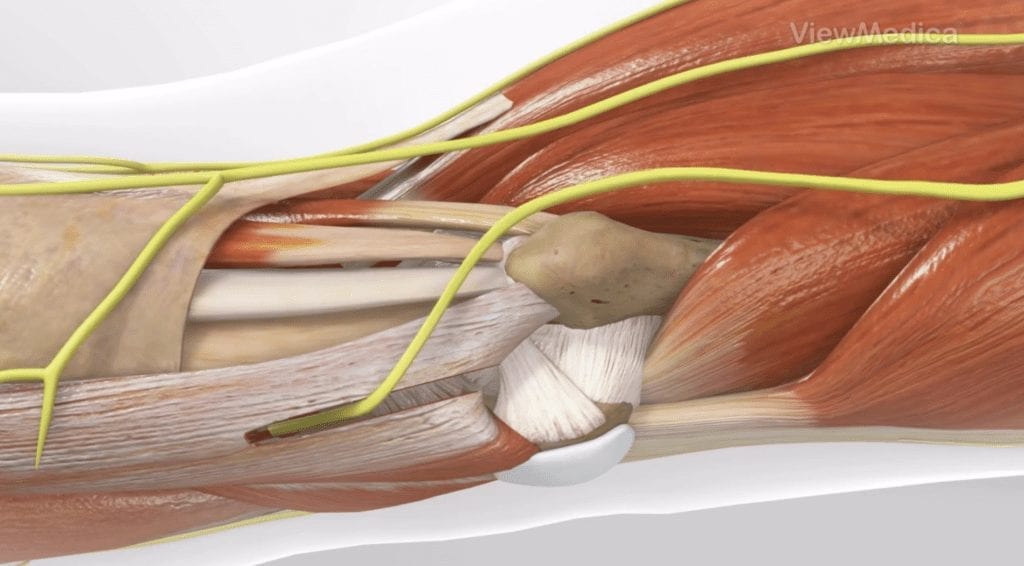 Cubital tunnel release surgery is performed by entering the cubital tunnel through its “roof” of soft tissue. Opening this “roof” decreases compression on the ulnar nerve and gives the orthopedic surgeon additional space to reposition the nerve as needed to prevent future entrapment. Later, as the ligaments and tissues begin to heal, the cubital tunnel will have additional space for the ulnar nerve. Barring any significant deformations in the elbow, which may require the application of additional treatments, patient outcomes for this surgery are very good.
Are There Risks to This Surgery?
It goes without saying that all surgeries come with risks, but patient outcomes suggest that cubital tunnel release surgery is a safe treatment option. Most patients undergoing cubital tunnel release surgery have a positive experience with no significant complications; however, it must be noted that infection, nerve damage, pain, elbow weakness, and obstructed range of motion may occur for some patients.
Your orthopedic surgeon will discuss the risks with you long before surgery. It is during this time that you will learn whether or not your medical history or current health suggest that you are at a heightened risk of surgical complications. Recovering from surgery may take two to three months or longer, so patients must get their work-related affairs in order prior to surgery, especially those who work in physically demanding industries that involve heavy lifting.
How to Prepare for Cubital Tunnel Release Surgery?
Preparing for cubital tunnel release surgery is a relatively straightforward process. Keep in mind that cubital tunnel release is performed under general or regional anesthesia, so you will want to follow your surgeon’s instructions closely leading up to surgery to minimize your risk of complications. You will want to avoid taking blood thinners the week leading up to surgery unless your medical provider instructs you otherwise. Most patients can resume taking their normal medications the day after surgery. Do not eat or drink after midnight the night before surgery and try to get some rest before the procedure. Before you know it, the procedure will be complete and you’ll be on your way home with a friend or family member at the wheel and a healthy elbow in a splint.
How to Prepare for Cubital Tunnel Release Surgery?
After surgery, the wound will be cleaned, sanitized, and dressed. During the first ten to fourteen days of recovery, the bandage must be left in place and kept dry. The stitches used to close the incision will dissolve on their own, so there’s no need to revisit your orthopedic surgeon to have the sutures taken out. When you return to have the bandage removed, you will be able to shower and lightly clean the wound; however, immersing the wound in water is not advised until it has had another few days to heal. Do not apply any ointments or other topical medicines that have not been prescribed by your medical provider. Most people utilize a sling for several weeks after surgery.
Limit movement of the elbow and do not perform physical tasks until it has completely healed. Lifting, pushing, or pulling heavy objects could reaggravate the ulnar nerve causing complications. Realistically, you shouldn’t expect to put any weight your elbow until two to three months after surgery. Of course, any exercises prescribed by a physical trainer can be performed safely, but only once six weeks have past. Be patient during the recovery process. You’re probably in a rush to get back to your normal lifestyle, but your elbow needs time to heal. If you want long-term results, you have to be willing to give it the time and care it deserves. Cubital tunnel release surgery results can be gradual, with post-surgical improvements extending for up to eighteen months. If surgery fails to return sensation to the ulnar nerve, it will still prevent the condition from progressing.